Part 1: Why Every Great Smart Home Starts With a Smart Plan
Categories
Explore the power of planning lighting, shading, and AV together
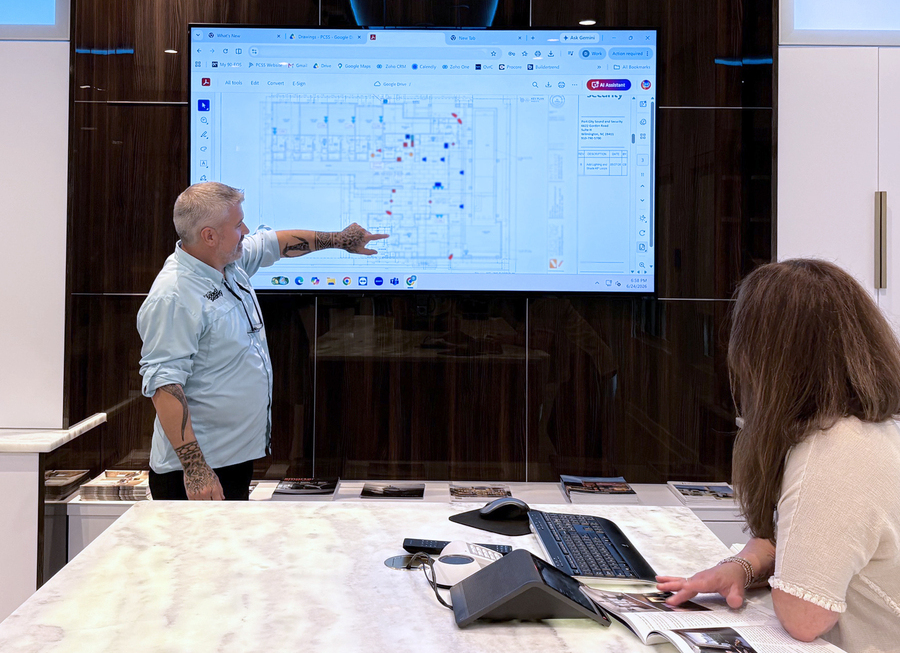
Building a luxury smart home is full of exciting decisions, yet one of the most important steps happens before a single wire is installed. Long before speakers are mounted, shades are hung, or lighting scenes are programmed, Port City Sound and Security, Inc. takes the time to understand how your home will be used each day.
If you're building a new home or preparing for a major renovation, the design stage is the perfect time to think beyond individual products and focus on the complete experience.
SEE ALSO: The Golden Balance: Celebrating 25 Years of Port City Sound and Security
Start With Your Lifestyle, Not Your Equipment
It's easy to begin a smart home project by thinking about specific products. Maybe you've imagined a larger TV, whole-home audio, or motorized shades in the primary suite. Those ideas certainly matter, but they become much more valuable when they're part of a bigger vision.
Our discovery process explores how you use each space throughout the day. Looking at your routines first helps us create a plan that feels natural because every technology decision supports the way you truly live.
As the engineering team points out, timing is everything.
"Homeowners should start thinking about these solutions during the design and architectural stage," said Caleb Barefoot, system designer at Port City Sound and Security. "Certain factors, such as shades and speaker placement, require structural changes or additions to the framing. If the home is already being framed, retrofitting ends up costing significant time and money."
The Hidden Details That Shape a Luxury Smart Home
Many of the features that give a high-end smart home its clean, uncluttered appearance depend on decisions made during the architectural design phase. Recessed pockets for motorized shades, architectural speakers, and concealed televisions all require coordination before framing is complete.
Take motorized window treatments, for example. Everyone loves the idea of shades that silently descend at sunset.
"Most people don't realize that if you want the roller hardware to be invisible when the shades are up, you have to plan for it during the framing stage," explains Dan Perry, business development specialist. "To hide them, the builder needs to construct recessed shade pockets up in the ceiling or window headers before the drywall goes up. If this isn't planned early, you are stuck with exposed, bulky fascias or valances mounted on the wall."
Curing "Wall Acne"
Another major revelation that occurs during discovery is how we handle lighting switches. In a standard home, if a room has overhead lights, sconces, a ceiling fan, and accent lighting, you end up with a messy bank of four or five switches cluttering the wall. In an open-concept space, this "wall acne" is a massive eyesore.
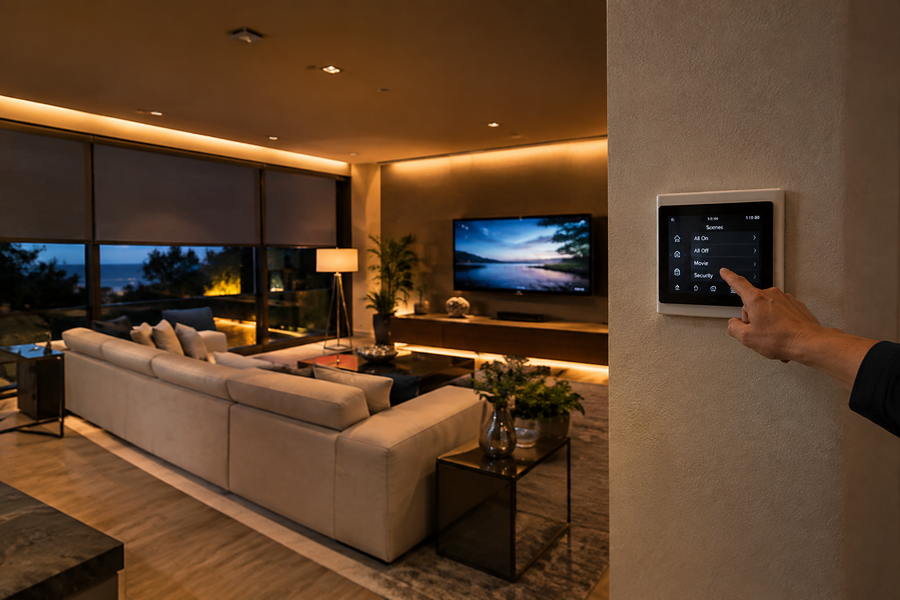
During discovery, homeowners realize they don't just want "smart switches." They want centralized lighting control. This involves wiring all the actual lighting loads back to a hidden central panel. In the living space, we replace those cluttered switch banks with a single, elegant keypad with custom-engraved buttons, such as "Entertain," "Cooking," and "All Off").
The Infrastructure Behind a Seamless Experience
A reliable smart home is built on an infrastructure that most people never see. While wireless devices are part of everyday life, a premium smart home performs best when supported by a robust wired network.
There is a common misconception that because smart home gear is "wireless," you don't need cables. The reality is the exact opposite: a robust wireless experience requires a massive wired infrastructure.
"You can't rely on a single router from your ISP," Barefoot said. "You need strategically placed Wi-Fi access points wired directly back to a network switch. Furthermore, every stationary smart TV or Apple TV should be hardwired via Cat6 cable. This reserves your Wi-Fi bandwidth for phones, tablets, and laptops."
Future-Proofing with "Smurf Tubes"
Technology changes rapidly. By running empty, flexible conduit (often called "smurf tubes") from your central equipment rack to key locations, such as the primary TV wall and the main internet provider demarcation point, we ensure a clean path. You can easily pull new, yet-to-be-invented cables 10 years from now without tearing open the drywall.
Rethinking the Equipment Hub and Thermal Management
All this centralized tech—network switches, AV receivers, lighting controllers, and processors—has to live somewhere. Homeowners often initially assume they can just shove the gear into a standard coat closet or a living room credenza. However, once they see the true scope of the equipment, the priority shifts to creating a dedicated, thermally managed AV rack or closet to prevent hardware from overheating and failing prematurely.
While the Walls Are Open
This infrastructure extends to the perimeter of your home, too. Homeowners focus heavily on the interior and forget the exterior perimeter until the landscaping is finished. It is more cost-effective to pull wire during the rough-in phase, but very expensive to trench through a finished concrete patio or pristine lawn later. Early planning allows us to seamlessly run wires for landscape audio (like buried subwoofers) and Power over Ethernet (PoE) security cameras straight to the eaves while construction is underway.
The True Benefits: Aesthetic Invisibility and Instant Response
When systems aren't planned early, you are forced to retrofit. That means soundbars sitting on mantels, power cords dangling from wall-mounted TVs, and bulky shade motors exposed on window frames. Early integration completely eliminates this visual clutter:
- Flush-Mounted Everything: Architectural speakers can be mudded directly into the drywall so they are completely invisible (literally painted over), rather than having plastic grilles disrupting a beautiful ceiling.
- Invisible Displays: You can plan for TVs that disguise themselves as framed art (like the Samsung Frame), drop down from motorized ceiling lifts, or are hidden behind custom motorized artwork.
- Instant, Hardwired Response: When you retrofit a smart home, components have to talk over Wi-Fi. If your Wi-Fi lags, your lights delay. When engineered from the start, commands don't have to bounce through cloud servers. When you press a button on the wall, the processor sends a hardwired signal to the lighting panel, and the response is swift.
One Button Can Transform the Entire Room
Instead of switching between multiple apps or searching for the right remote, a unified system allows you to activate personalized scenes with a single button press. A single custom-engraved button on the wall labeled "Entertain" can execute a complex string of commands instantly:
- The living room lights dim to 20%.
- The motorized shades lower to block the glare.
- The whole-home audio system starts playing a specific playlist at a perfect background volume.
Passing the "Guest Test"
If you buy smart home gear piecemeal after moving in, you usually end up with "app fatigue"—one app for the lights, one for the thermostat, one for music, and a separate remote for the TV.
"The fatal flaw of DIY, app-based smart homes is that the 'smarts' live entirely on the homeowner's smartphone," Perry said. "If a house guest, babysitter, or grandparent wants to turn on the patio lights or watch a movie, they can't—unless they download three apps and ask for your passwords."
A unified system moves control back to the house itself. You can hand a guest a single, dedicated remote or point them to an intuitive wall touch-screen where hitting "Watch Apple TV" handles all the complex video routing and amplifier switching automatically. The house becomes smart for everyone inside it, not just the person who built the network.
Build Your Smart Home on the Right Foundation
Planning early creates opportunities for cleaner design, dependable performance, and technology that feels effortless to use every day.
If you're building a new home or planning a major renovation, contact Port City Sound and Security to start the conversation. Together, we can create a smart home plan that complements your home, your lifestyle, and your goals for years to come.
Stay tuned: This is just the beginning of your smart home journey. Stay tuned for Part II: The Foundation (Infrastructure & Engineering), where we dive deep into the invisible systems that keep your luxury home running flawlessly.