Why the Technology You Never See Is What Makes Your Home Perform Flawlessly
In Part One of this series, we looked at the design vision behind a great AV integration: art frames that hide display screens, flangeless speakers finished to disappear into ceilings, motorized shades that drop seamlessly out of sight, and intuitive keypads that eliminate coffee-table clutter.
That vision only holds up if the groundwork behind it does too. This second post in our series takes a closer look at that infrastructure: what happens behind the walls of your Wilmington, NC, home long before drywall goes up—and why true luxury technology should be felt and heard, but never seen.
See Also: Why Every Smart Home Begins With a Smart Plan
The Centralized Equipment Rack: Eliminating AV "Furniture"
It used to be standard practice to stack cable boxes, streaming devices, and receiver amplifiers inside living room base cabinets. "Customers were constantly complaining about losing valuable storage space in their main living areas to cluttered stacks of gear," said Caleb Barefoot, System Designer at Port City Sound and Security.
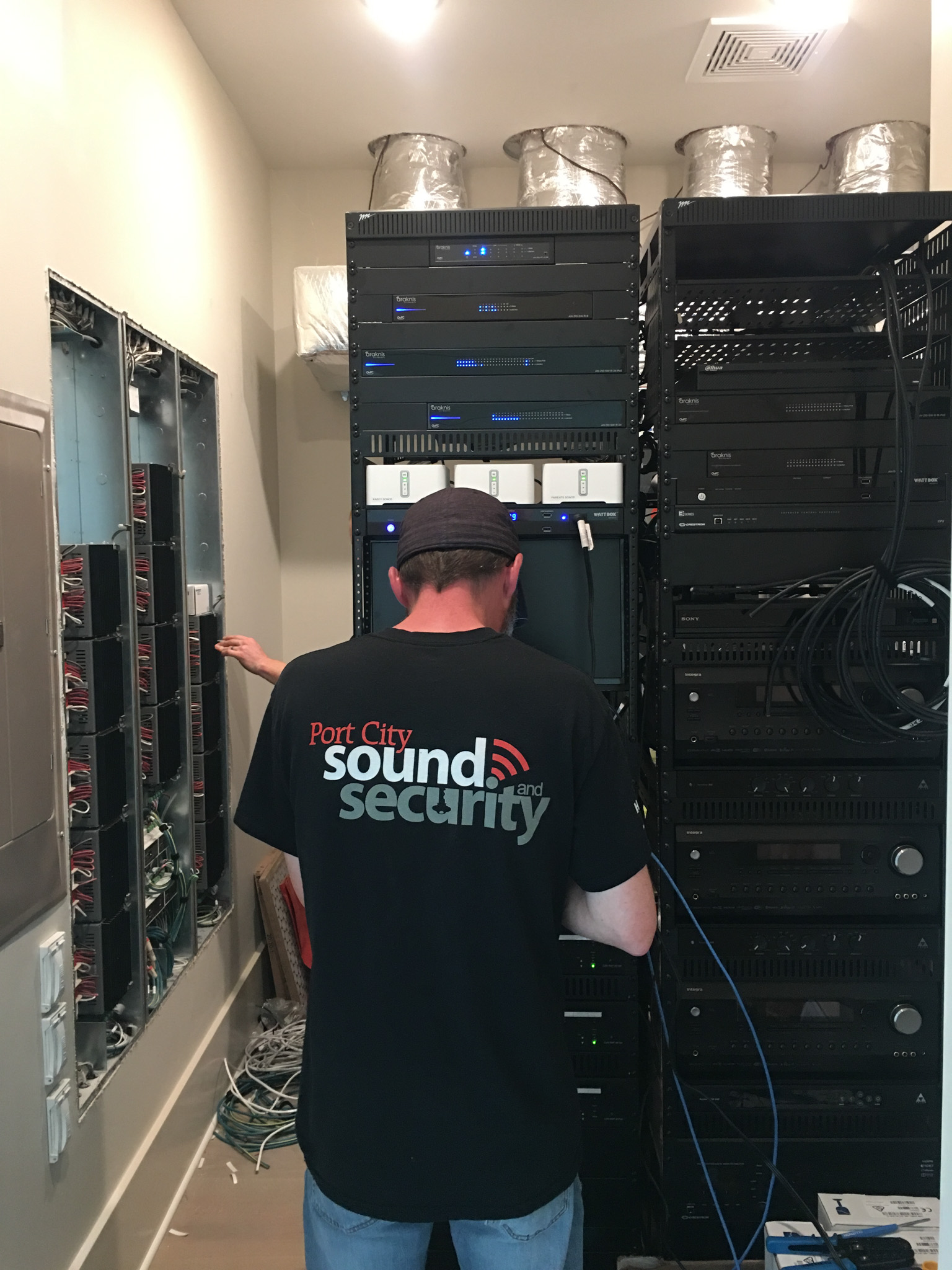
The modern solution removes AV hardware from living spaces entirely. Today, all gear lives in a single, centralized equipment rack tucked neatly into a dedicated mechanical room or closet. Depending on system complexity, a rack setup scales precisely to the home's needs:
- Small Racks (<2 ft}: House basic networking equipment like Araknis routers and access points.
- Medium Racks (2-5 ft): Accommodate whole-home distributed audio powered by Sonos amplifiers, Crestron NAX, or Triad audio matrix switchers.
- Full-Size Racks (5-7 ft): Support comprehensive smart homes featuring Control4 or Crestron Home automation, Integra AVRs for dedicated surround-sound theaters, and WattBox IP power management with uninterruptible power supply (UPS) battery backups.
Centralizing gear requires proper thermal management. Equipment racks are equipped with dedicated ventilation fans, louvered doors, or placed in rooms with generous air volume. "On larger, high-performance installs, we work directly with the builder to engineer dedicated HVAC solutions," said Barefoot. "For example, on a recent project housing two full-size AV racks, we coordinated the installation of a dedicated mini-split cooling system inside the equipment closet to ensure peak hardware performance and longevity."
The Single-Wire Backbone: Uncompromising Speed and Stability
While wireless tech is convenient, leaning on Wi-Fi for critical home entertainment quickly leads to bottlenecks.
Think of Wi-Fi like a busy traffic intersection where every smart device competes for the same lane. A hardwired cable connection acts as a dedicated express lane straight to your core network router. Wi-Fi signals degrade through building materials, such as brick, concrete, and metal framing. A physical cable consistently delivers maximum bandwidth for uninterrupted 4K/8K streaming and audio latency.
Building a strong physical backbone requires matching the right cable spec to the specific job:
- Cat6: The modern standard for residential runs, easily handling up to 10 Gbps speeds over typical home distances.
- Cat6a: Used for larger estates or commercial spaces requiring 10 Gbps performance over extended distances via a thicker gauge cable.
- Cat7 S/STP: Fully shielded cabling specified for distributed video signals to provide maximum immunity against electromagnetic interference.
- Multi-Mode Fiber Optic: Deployed when running connection lines beyond the standard 100-meter (328 ft) limit of category cables—ideal for connecting detached guest houses, pool cabanas, or boat docks up to 1,000 feet away.
- Single-Mode Fiber Optic: Reserved for extreme distances exceeding 1,000 feet, delivering future-proof speed capability.
Why Framing Stage Matters
This infrastructure must be pulled during the framing phase while walls are wide open. Retrofitting after sheetrock goes up is costly and limiting.
"We once worked with a client who opted to run older Cat5e wiring during construction instead of upgrading," recalled Barefoot. "A few years later, when their internet provider offered 2.5 Gbps fiber speeds, the only way to route those speeds through the home's prewired closet without tearing open sheetrock throughout the house was to locate the main router on top of a piece of furniture in an exterior room. Prewiring correctly during framing avoids those exact trade-offs."
To protect against technology shifts, Port City Sound and Security installs flexible conduit alongside primary cable runs. If internet service providers transition technologies or standards evolve down the line, new wiring can be pulled directly into the central equipment room without opening a single wall.
The Trade Triad: Architect, Interior Designer & Electrician Collaboration
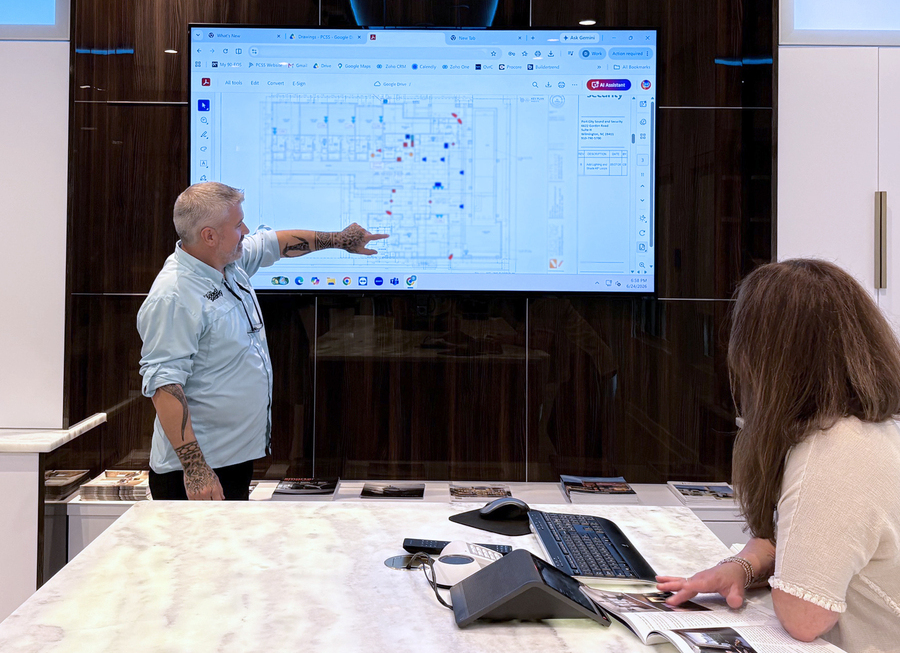
Flawless AV performance requires early collaboration with the key build partners shaping your home: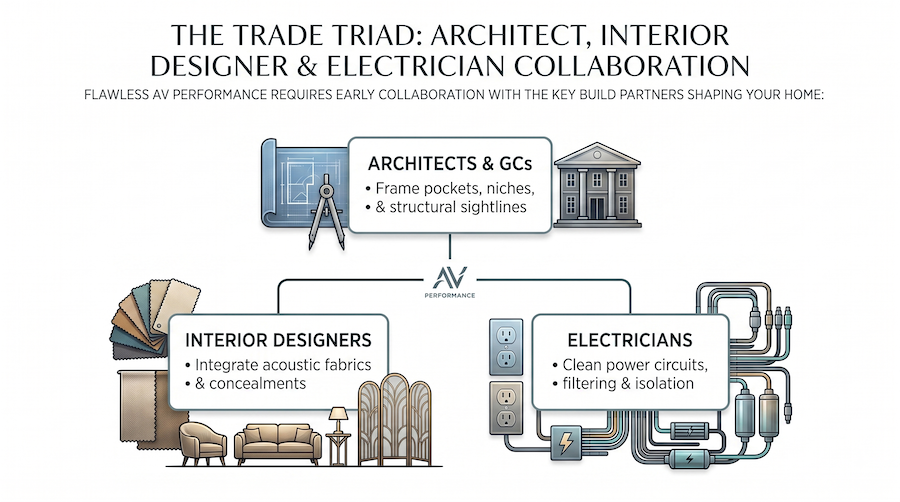
- Architects & General Contractors: Early plan reviews ensure structural framing accounts for recessed shade pockets, flush TV niches, and speaker locations. "Recently on a large project, the architectural plan featured a custom ceiling with an intricate lattice pattern," shared Barefoot. "Because we were involved early, we specified architectural speakers with square grilles sized to match the lattice grid perfectly."
- Interior Designers: Working together from Day One allows integration of acoustically transparent fabrics over hidden speakers, custom millwork concealing displays, and seamless alignment between architectural finishes and tech hardware.
- Electricians: Clean, isolated power is fundamental to high-end audio and video quality. We coordinate with electricians to supply dedicated circuits combined with WattBox power conditioning. These units feature Safe Voltage Technology, which automatically disconnects sensitive gear during high or low voltage spikes, and Isolated Filter Banks, which eliminate the electromagnetic and radio frequency interference that causes annoying speaker hum and video line noise.
Engineered to Perform
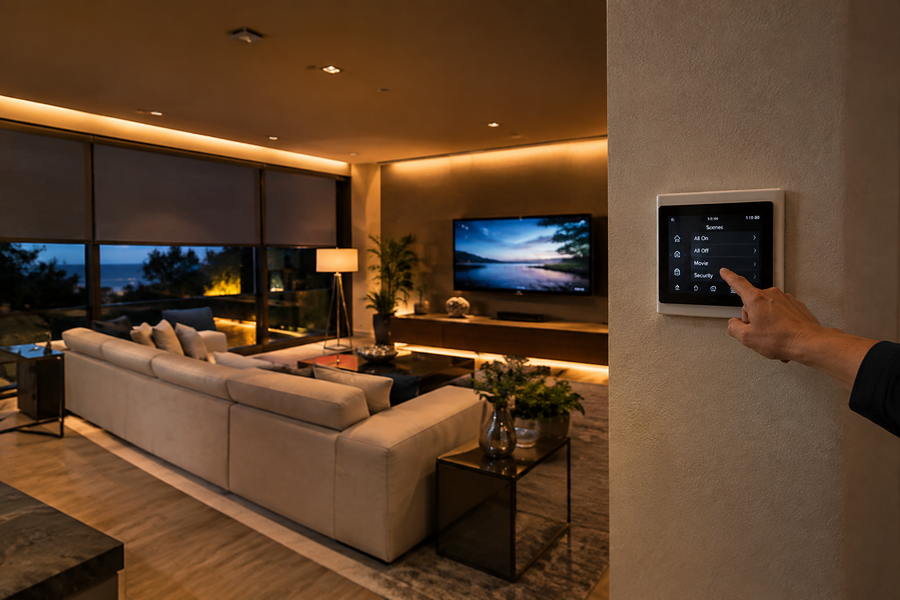
The home technology you end up noticing and enjoying—the press of a button that sets lighting scene moods, pristine audio flowing through every room, or a dedicated home theater—only performs reliably because of the invisible engineering planned months before move-in.
Ready to build a smart home system designed to perform seamlessly for years to come? The integration of this foundational engineering requires specialized expertise and early partnership across all build trades. By engaging our team early, we ensure every detail is perfectly coordinated with your architect, interior designer, and electrician for a truly flawless experience. Fill out our contact form to start collaborating with our team on your next project and bring your vision to life without compromise.